Three things became structurally clearer. China’s AI ecosystem is compounding differently than the West and faster than people realise. The hyperscalers are quietly becoming the most powerful investors in the market they also happen to run. And the consumer AI habit is forming at scale with no dominant player in sight.
Oh, and the most valuable training data in AI? It's been sitting in gaming servers this whole time. Plus: the real reason Hollywood is collapsing — and why it has almost nothing to do with AI.
The gap between the headline and the actual story has never been wider. Here’s the actual story.
SUMMARY
🇨🇳 China’s AI Labs Stopped Competing. They Started Coordinating. DeepSeek is open-sourcing the hard infrastructure work so every other Chinese lab can specialize above it. The model layer is commoditizing. Open source didn’t kill monetization; it disciplined it. And the ecosystem is compounding faster than anyone expected
🎬 Hollywood Is Dying. The Real Reason Is More Boring Than AI. Shoot days in LA halved in three years. But the cause isn't AI or creative cowardice — it's tax arbitrage. AI is the first lever that lowers cost instead of relocating it. Whoever owns the low-cost, high-volume model when financing flips, wins.
🎙️ OpenAI Just Entered the Voice Wars. ElevenLabs Has a Distribution Problem. Three real-time audio models. GPT-5-class reasoning in a live voice agent. Translation across 70 languages. This isn’t about better chat - it’s a direct play for call centres, enterprise translation, and meeting infrastructure. The voice layer is now genuinely contested.
🎮 The Most Valuable AI Dataset Isn't Text or Images. It's Your Game Replay. NVIDIA just open-sourced its entire world model stack - DreamDojo, 44,000 hours of video, Apache 2.0, free. "We built a world model" is no longer a moat. What's left is proprietary action-labeled data at scale. Which is exactly what gaming generates - and why every serious world models lab quietly has a gaming angle.
💰 Google and Meta Had Record Quarters. Neither Launched a New Product. Meta turned AI into an ad multiplier; impressions up 19%, price up 12%, simultaneously. Google Cloud grew 63% and is now profitable at 33% margins. And buried in the footnotes: hyperscalers booked $53B in private AI investment gains this quarter alone.
📱 AI Apps Are Now a Consumer Habit - And Nobody Has Won Yet Downloads, time spent, and revenue all hit new highs in Q1. AI app revenue nearly tripled year-on-year. Less than 20% of enterprises use just one AI vendor. There’s no winner-takes-all - and that gap is still wide open.
🇨🇳 DeepSeek Just Made Every Chinese AI Lab Smarter. That's the Underreported Story
The easy headline on DeepSeek V4 was the pricing shock. Another cheap Chinese model, another round of Nvidia volatility, another “is this the end of OpenAI” cycle.
That’s not the story.
The real story is structural - and if you’ve watched how China builds industries, it should look familiar.
You’ve seen this playbook before
In 2009, China decided it would dominate electric vehicles. The government picked winners, subsidised manufacturing, protected the domestic market, coordinated capital across the supply chain, and mandated adoption through state-owned enterprises. Western analysts called it inefficient. BYD now outsells Tesla globally.
The same playbook is running on AI - and it’s further along than most people realise.
China’s 15th Five-Year Plan mentions artificial intelligence 52 times - four times more than its predecessor. AI is no longer one priority among many. It is the organising principle of China’s modernisation agenda for the next five years. The stated target: 90% penetration of AI-enabled devices and applications across Chinese industry by 2030, with the core AI industry — valued at roughly 1.2 trillion yuan today — targeted to surpass 10 trillion yuan within the plan period.
Major Chinese banks have begun ramping up lending to technology firms, with some targeting around 30% growth in loans to innovation-oriented companies. State-owned enterprises are mandated to adopt AI. The financial plumbing — banks, state planning, compute procurement, industrial pilots — is being built to fund this at scale.
The constraint is chips. Export controls cut off access to frontier Nvidia GPUs. But like BYD turning battery constraints into a competitive advantage by vertically integrating the supply chain, China’s AI ecosystem is turning compute constraints into a coordination advantage.
The mega-lab thesis
Look at what each major Chinese lab is actually doing:
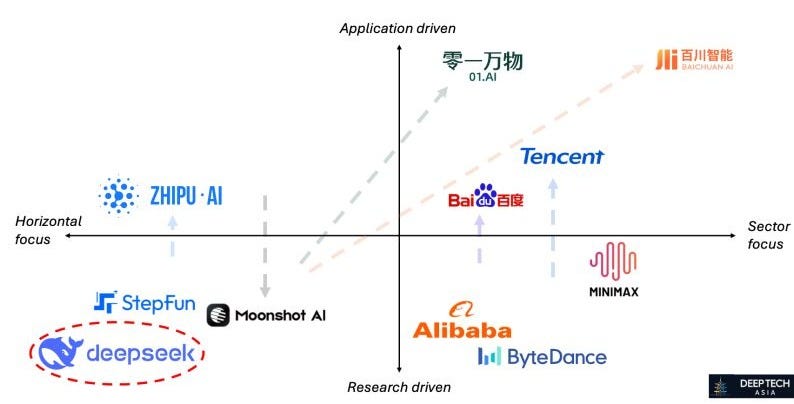
DeepSeek owns foundation-layer architecture and inference optimization. Z.ai owns coding and enterprise reliability. Kimi owns long context and agentic orchestration. MiniMax owns multimodality and low-cost inference. Alibaba, Tencent, and ByteDance own distribution — cloud, commerce, short video, enterprise workflow.
These companies still compete commercially. But technically, the ecosystem is becoming modular. Each lab specialises. And because DeepSeek releases open weights, every other lab absorbs the base-layer innovations without rediscovering them independently.
The analogy: imagine OpenAI solving a hard architecture problem and publishing it so Anthropic and Google could build on top. That’s not how the US system works. In China, under compute constraint and government coordination, that’s increasingly how it does.
Open source as R&D coordination
V4 reportedly delayed launch by three months to ensure the model ran properly on Huawei’s Ascend chips before shipping. Most labs can’t afford that — they need to launch, monetize, raise, repeat. DeepSeek, backed by quant hedge fund High Flyer with no immediate monetization pressure, absorbed the cost for the ecosystem. Every other Chinese lab now has a Huawei deployment reference point without spending three months on it themselves.
That’s not competition. That’s shared R&D with a commercial wrapper — coordinated the same way China coordinated battery technology across its EV supply chain.
The monetization question
If you open-source the model, how do you make money? Same way open-source software did. Users aren’t paying for model weights — they’re paying for managed inference. Reliability, latency, routing, tooling, enterprise deployment. Self-hosting a frontier model is hard. Most users won’t.
What open source changes is the ceiling. Sophisticated buyers can now compare against a self-hosting cost floor, which means you can’t charge unlimited premium pricing for generic inference. Open source doesn’t kill monetization. It disciplines it.
The investor takeaway
Three things worth sitting with:
First, expect a wave of Chinese AI and advanced semiconductor firms to tap capital markets in 2026 — GPU players, AI model developers, and infrastructure companies all moving toward IPO. The Five-Year Plan is the structural tailwind. The question for global investors is whether these are accessible and at what risk premium.
Second, any Western AI company competing on generic inference is now competing against a state-coordinated ecosystem with no margin pressure and a mandate to win. That’s not a product competition. It’s an industrial policy competition. The playbook from EVs suggests the right response isn’t to match price — it’s to own the layer that can’t be commoditised: workflow integration, proprietary data, and switching costs.
Third, the BYD moment in AI — when a Chinese model goes globally dominant in a specific category — hasn’t happened yet. But BYD didn’t look like a threat until it suddenly was. The labs building genuine specialisation on top of DeepSeek’s open foundation — coding, orchestration, multimodal inference — are the ones worth watching. One of them will be the BYD of AI. The question is which category it takes first.
🔗 Sources: Grace Shao | SCMP | Reuters
🎬 Hollywood Isn’t Dying Because of AI. The Real Reason Is More Boring

Luma’s CEO Amit Jain said something provocative in a recent Stanford lecture: Hollywood has been dead for years, AI had nothing to do with it, and the killer was a private equity mindset. He sells the cure, so we checked his claims against independent data. The symptom is real. The diagnosis is half right.
What checks out
Hollywood doesn’t make movies in Hollywood anymore. Shoot days in LA fell to 19,694 in 2025, down from 36,792 three years earlier, a near 50% collapse. Of 155 big-budget films between 2018 and 2025, only 34 shot any part in LA. In Q1 2025, 46% of US scripted titles began production entirely abroad. His “Hollywood finances movies, it doesn’t make them” line is just true.
The franchise problem is real too. Wide theatrical releases keep shrinking - 112 in 2025, down from 120 in 2019. Fewer, bigger, safer bets. Netflix runs the opposite model — high volume, lower budgets, global. The PE-versus-venture contrast holds.
Where he’s wrong
Jain blames creative cowardice. The data says tax arbitrage. The UK, Canada, and Australia offer incentives without per-project caps — decisive for $100M+ films. Productions didn’t flee LA because executives lost their nerve. They fled because other places pay them to. The PE story is a nice narrative draped over a boring one.
His receipts need caveats too. The “first major LA production in five years” line is sales talk — feature production actually rose ~10% year-over-year in late 2025. And the industry’s real recovery bet isn’t AI. It’s policy: California just expanded its film tax credit to $750M, up to $3.75B over five years.
Why it still matters
The cause is structural - production chases subsidies, not creative philosophy. Which is exactly why AI is more interesting than Jain’s framing suggests. Every existing lever - credits, relocation, labor cuts — moves cost somewhere else. AI is the first one that lowers it instead of moving it.
If execution gets cheap enough, the financing logic flips: from PE (few large de-risked bets) to venture (many cheap shots, the portfolio finds the hit). Not because studios get braver - because the math stops punishing volume.
That’s a thesis, not a result. The data doesn’t show AI reversing anything yet. It shows an industry with an unsustainable cost base and no answer except subsidies that relocate the problem. The question isn’t whether Hollywood is dying in its current form. It is. It’s who owns the low-cost, high-volume model when the financing logic finally flips. Watch cost structure, not catalogue.
🔗 Sources: Amit Jain, CS153 Stanford (note: Jain is Luma’s CEO); Hollywood Reporter; FilmLA; Luminate
🎙️ OpenAI Just Entered the Voice Wars. The Real Fight Is for the Phone Call.
OpenAI launched three new real-time audio models last week - GPT-Realtime-2, GPT-Realtime-Translate, and GPT-Realtime-Whisper - all available through its developer API. The framing was developer tools. The actual move is a direct play for the most valuable real-time audio use cases in enterprise: customer support, sales calls, live translation, and meeting transcription.
GPT-Realtime-2 is the headline - OpenAI’s first voice model with GPT-5-class reasoning, capable of handling interruptions, calling tools mid-conversation, and maintaining context across 128,000 tokens. That’s not a voice assistant. That’s a phone agent that can actually do things while you’re talking to it.
Who they’re competing with and for what
This isn’t really about Siri or Alexa. The market OpenAI is going after is:
Call centres. The global call centre software market is worth over $30 billion. Every inbound customer service call is a token spend waiting to happen. Priceline is already using GPT-Realtime-2 for travel bookings handling flight searches, hotel adjustments, and itinerary changes through natural voice conversation. That’s the template.
Live translation. GPT-Realtime-Translate handles 70+ input languages into 13 output languages, keeping pace with the speaker in real time. The targets are multinational enterprise, education, and healthcare; markets where professional translation currently costs serious money and moves slowly.
Meeting infrastructure. GPT-Realtime-Whisper delivers live streaming speech-to-text as the speaker talks — built for captions, meeting notes, courtroom documentation, and accessibility tools. This goes directly at Otter.ai, Fireflies, and every transcription tool sitting inside enterprise workflows today.
The ElevenLabs collision course
Two weeks ago we wrote about ElevenLabs entering music as a trojan horse for owning the full audio stack. OpenAI just dropped three models that compete directly with ElevenLabs’ core voice business - real-time TTS, transcription, translation. ElevenLabs’ moat has always been audio quality and legal positioning. OpenAI’s moat is distribution - every developer already has an API key.
The voice layer is now genuinely contested. Sub-300ms latency is table stakes. Reasoning capability is the new differentiator. And the company that wins won’t just be the one with the best voice — it’ll be the one embedded deepest in the workflow where the conversation is already happening.
🔗 Sources: Reuters
🎮 The Most Valuable AI Dataset Isn't Text or Images. It's Your Game Replay
Moonlake just announced a world models company founded by Chris Manning, Ian Goodfellow, and Fan-Yun Sun - three of the most credentialed researchers in the field. Their approach makes a non-obvious bet.
Generate beautiful, playable game environments to attract real human players. Collect the action-labeled data those players generate - what they saw, what they did, what happened next. Then discard the pixels entirely and train on abstract representations instead.
The game is the data collection mechanism. The AI is what gets built from it.
This matters beyond Moonlake. Games are turning out to be the most strategically valuable training environment in AI - not because they’re fun, but because of what they uniquely provide: spatially rich environments, clean action-outcome pairs, consistent physics, massive human engagement, and ground truth data on how humans observe, predict, and act in real time. That’s the exact data world models need. And it’s almost impossible to collect at this quality anywhere else.
The pattern is consistent: every serious world models company has a gaming angle. Decart built Oasis, a playable neural game engine, on the same logic. DeepMind’s entire early research program ran through Atari. GameNGen runs DOOM on a neural network at 20 FPS.
Which is why NVIDIA’s move matters
NVIDIA just open-sourced its entire physical AI stack - DreamDojo, DreamZero, Cosmos - Apache 2.0, free. The CUDA playbook applied to robotics: give away the software, sell the hardware. DreamDojo alone was trained on 44,000 hours of human video.
That move makes “we built a world model” not a moat anymore.
What remains defensible is proprietary data NVIDIA doesn’t have - which brings you straight back to gaming. The labs that own action-labeled gaming data at scale, millions of clips already tagged with in-game actions across thousands of environments, have something that can’t be open-sourced. You can’t release someone else’s gameplay data under Apache 2.0.
For investors: gaming data is not a gaming investment. It’s an embodied AI infrastructure play. The question worth asking is who owns the pipes — and whether they knew that’s what they were building.
💰 Google and Meta Had Their Best Quarter in Years. The How Matters More Than the How Much.
Two earnings prints. One week. A combined $166 billion in quarterly revenue. Google up 22%. Meta up 33% - fastest growth since 2021.
The headline numbers aren’t the story. How they got there is.
Meta: AI as a revenue multiplier, not a product
Meta’s quarter didn’t come from a new product. It came from making the existing one work better.
The ad engine got smarter. Ranking models retrained on richer signals. Same-day content now accounts for 30%+ of recommended Reels - double from a year ago. Result: impressions up 19%, price per ad up 12%, simultaneously. That combination almost never happens. More inventory, higher prices, same platform.
Eight million advertisers now use Meta’s AI creative tools - up from four million at the end of last year. Doubled in a single quarter. Zuckerberg said it plainly: AI is the operating system underneath $55 billion in quarterly ad revenue. The ROI isn’t theoretical. It’s in the print.
Google: a portfolio of monopolies, with one finally growing fast enough to matter
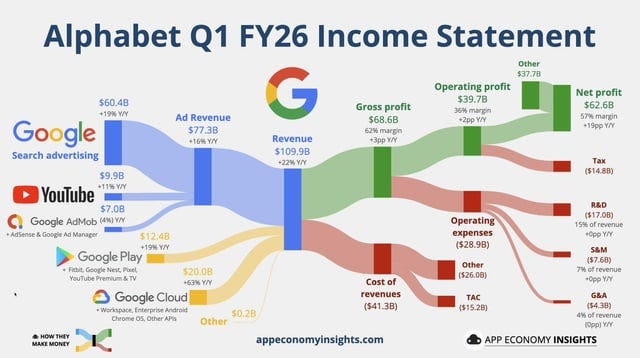
Google is best understood as a collection of dominant market positions — Search, Maps, Android, YouTube, Chrome, Play Store, AdWords, DV360 - sharing a balance sheet. Most are stable and slow-growing. Search grew 19%, exceptional at that scale, and the AI-kills-Search thesis got a hard rebuttal - queries at all-time highs, AI Overviews monetising comparably to traditional Search.
The real story is Cloud. Google Cloud grew 63% to $20 billion - the fastest growth rate among the three hyperscalers this quarter, outpacing both AWS and Azure. Operating margin went from 17.8% to 32.9% in a year. Backlog nearly doubled to $460 billion. Gemini is processing 16 billion tokens per minute via API - up 60% in a single quarter. Gemini Enterprise paid users grew 40% quarter-on-quarter. This isn’t catching up to AWS anymore. Enterprises are actively consolidating AI workloads around full-stack vendors and Google is the primary beneficiary.
The $190 billion capex guidance for 2026 is the other signal worth holding. Pichai said Google is “compute constrained in the near term.” That’s not a problem statement. That’s a demand signal.
The wrinkle nobody talked about
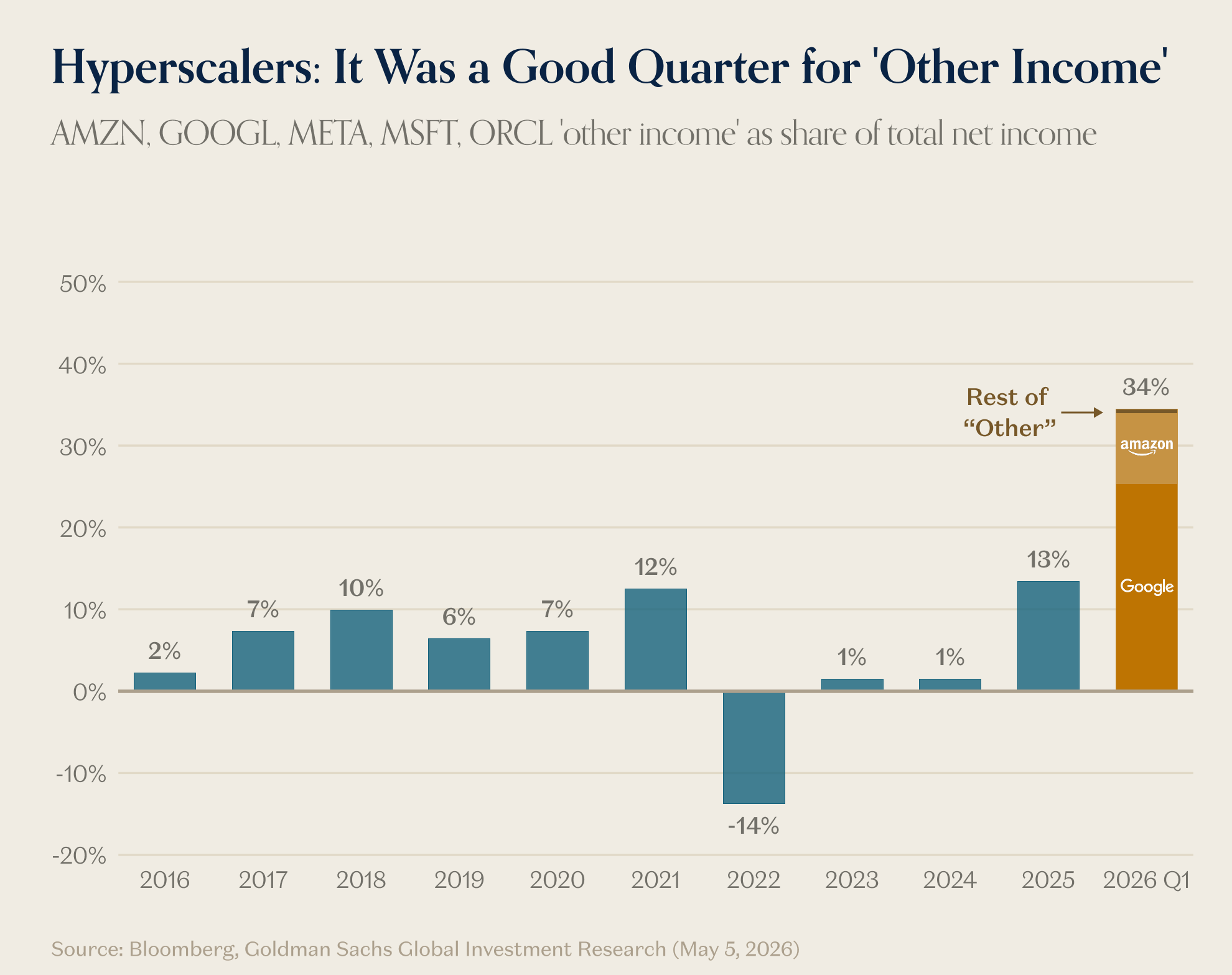
“Other Income” as a share of hyperscaler net income has bounced between 2-13% for a decade. In Q1 2026 it hit 34%.
Google flagged $37.7 billion “primarily from unrealized gains in nonmarketable equity securities.” Amazon disclosed $15.6 billion in gains from its Anthropic stake. Private market AI investments getting marked up — straight to the bottom line.
This is a new kind of capital asset. Not VC, not strategic M&A - something in between. Hyperscalers aren’t investing for financial returns. They’re buying compute spend, model access, and distribution lock-in. The markup is a byproduct. That makes them a fundamentally different counterparty than a traditional investor.
It doesn’t compete with VC - they come in late, in size, at the infrastructure layer. What it does change is the founder’s negotiation. When your cloud provider is also your investor, your biggest customer, and your model distributor, every conversation has a strategic dimension it didn’t used to.
The most powerful venture investors of the AI era might not have “ventures” in their name.
🔗 Sources: Alphabet Q1 2026 Earnings | Meta Q1 2026 Earnings
📱 In AI, Great Products Win Fast
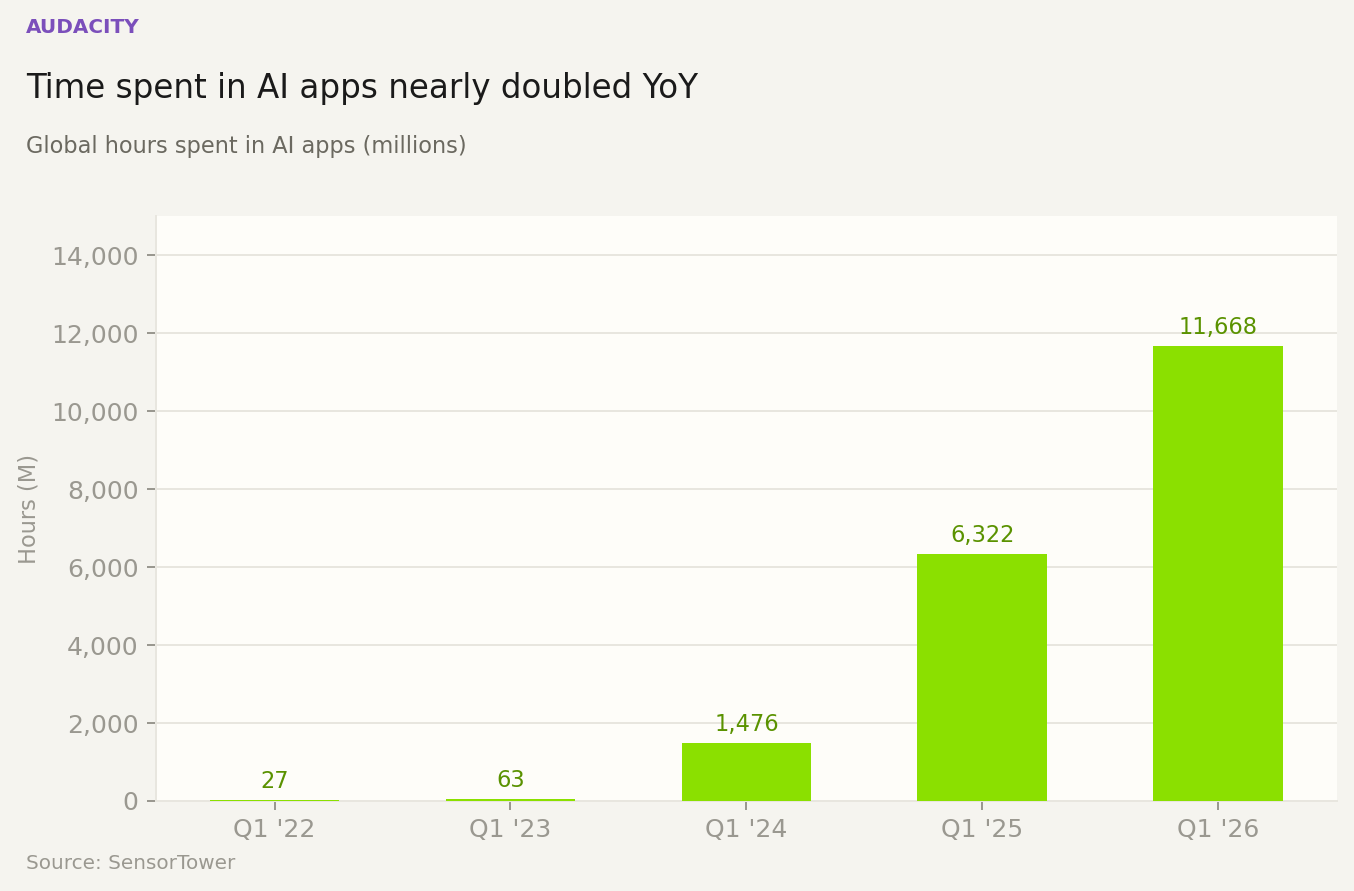
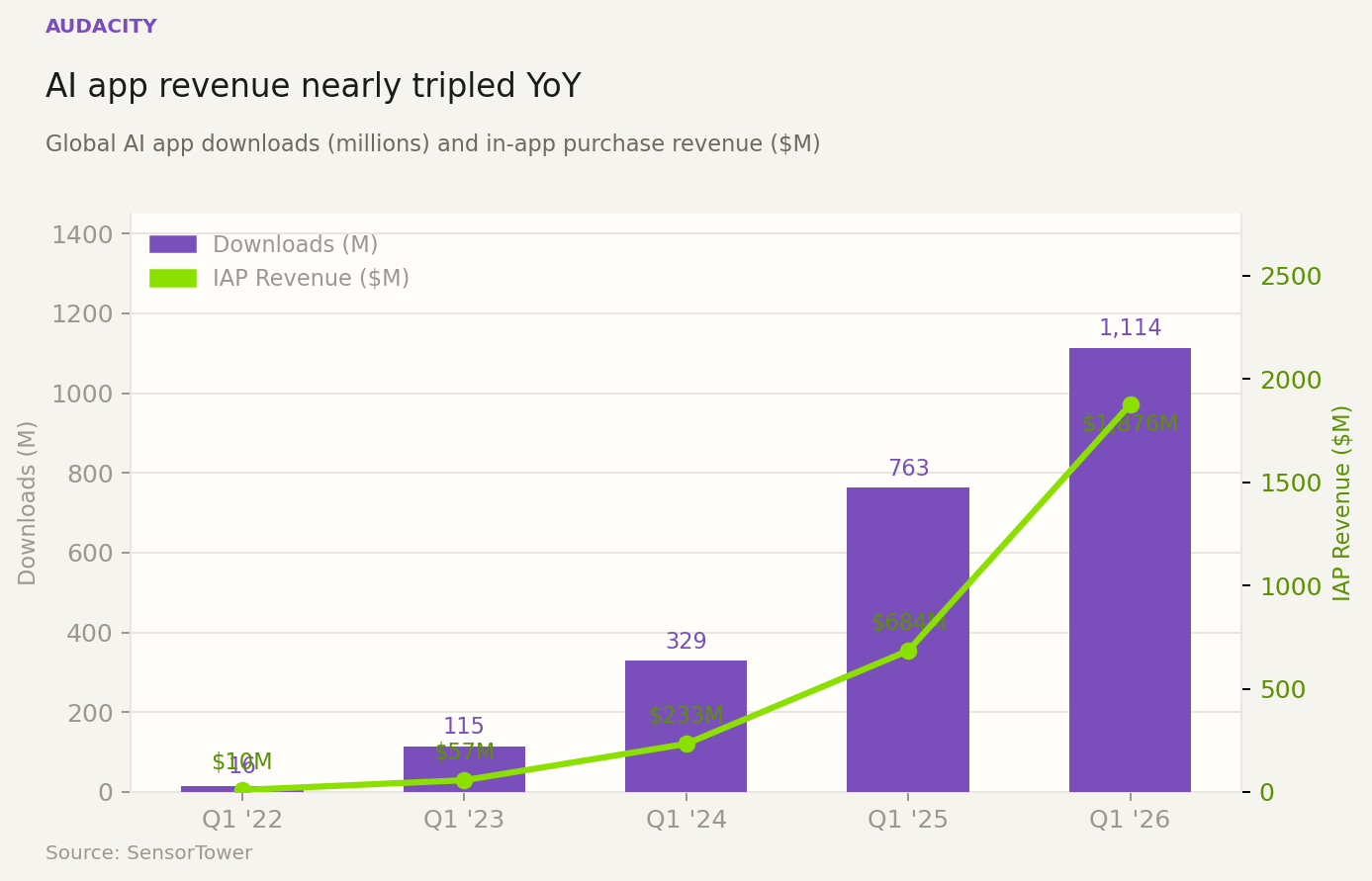
Downloads, time spent, and revenue in AI apps all inflected upward in Q1 2026 — and not marginally. AI app in-app purchase revenue nearly tripled year-on-year, hitting $1.876 billion in Q1 alone. Time spent in AI apps hit 11.7 billion hours — nearly double Q1 2025. For context, consumers spent 48 billion hours in generative AI apps across all of 2025 — 3.6x the total from 2024. Q1 2026 is already running ahead of that pace.
The monetization story is the most telling. In 2025, for the first time, consumers spent more on non-gaming apps than games - driven almost entirely by generative AI. ChatGPT alone generated $3.4 billion in global in-app purchase revenue, making it the third-highest grossing app of the year behind TikTok and Google One. People are paying for AI the same way they pay for Netflix. That’s a different consumer behaviour than two years ago.
And by 2026, consumer spending on generative AI apps is projected to exceed $10 billion, placing the category among the top three on mobile by in-app revenue.
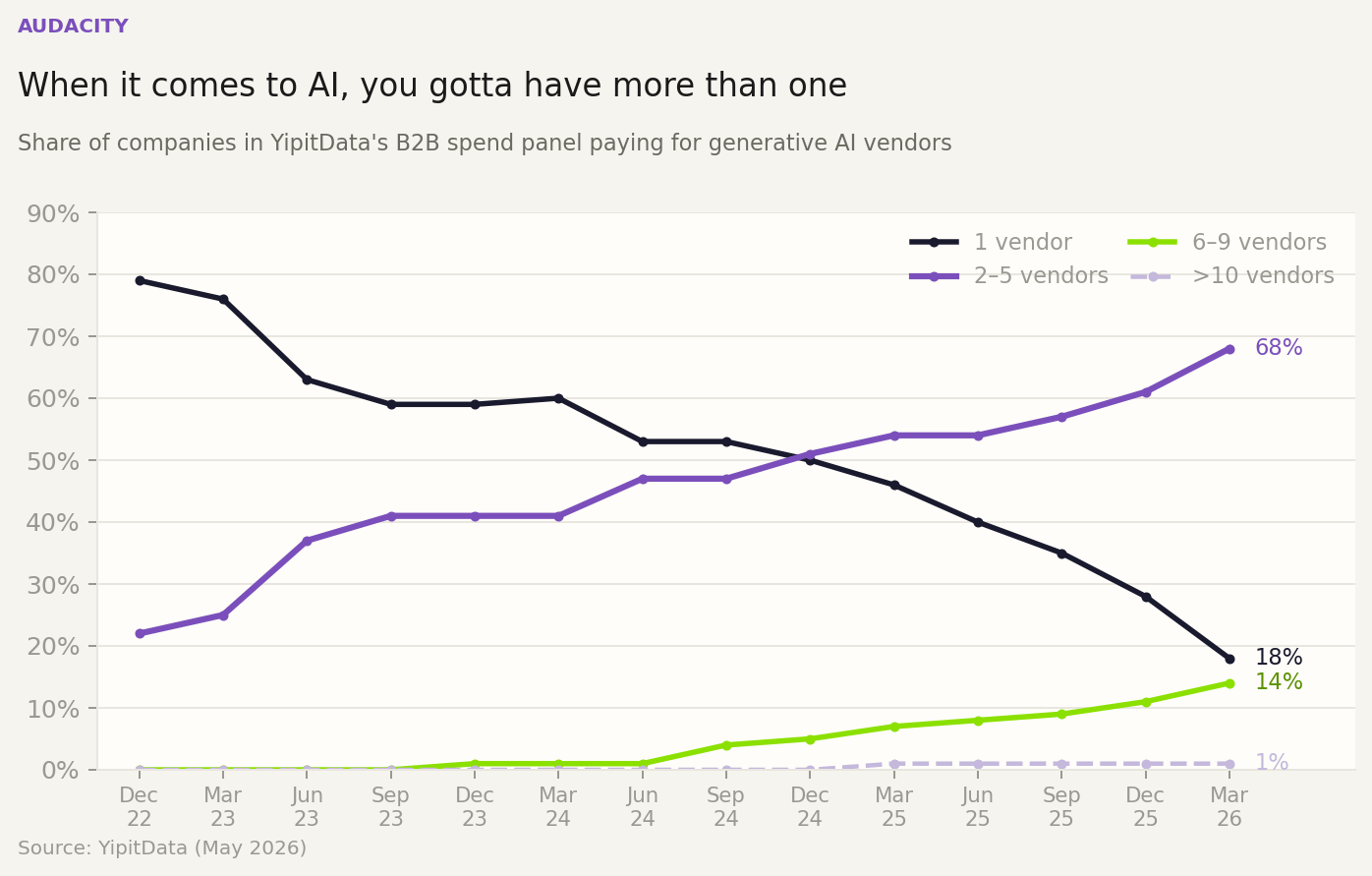
The B2B side tells a complementary story. Per YipitData, companies paying for just one AI vendor have dropped from ~80% in late 2022 to under 20% today. The 2-5 vendor cohort is now the dominant behaviour at 68%, and the 6-9 vendor cohort keeps climbing.
There is no winner-takes-all in B2B AI - at least not yet. Enterprises are running multi-model stacks, hedging across vendors, and treating AI tooling more like software infrastructure than a platform decision. For founders, that’s an opening. For investors, it means distribution and workflow integration matter more than model quality alone. And for the “one model to rule them all” thesis - the data keeps pushing back.
🔗 Sources: SensorTower | Venture Capitalist| YipitData